
Mirissa The whale-watching harbour of the south, blue whales November to April
The place
Mirissa is a small town on the south coast about 150 km from Colombo, with the largest fishing port on that coast. It is one of the island's main bases for whale and dolphin watching: blue whales are reported off this shore from November to April, with sperm whales and dolphins through the same months.
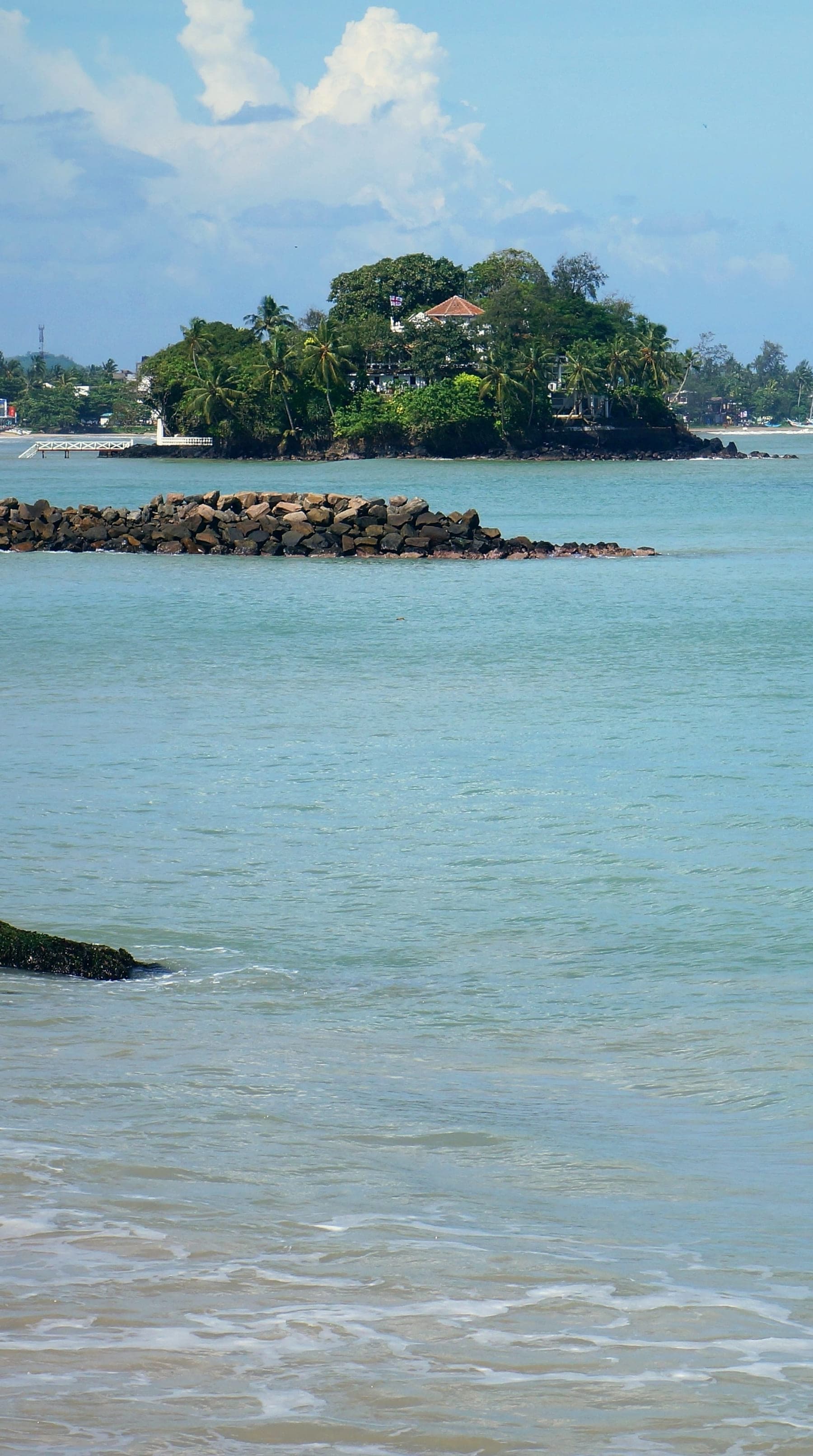
The beach curves between Parrot Rock and the headland of Coconut Tree Hill, with a quieter cove beyond, and the boats leave the harbour early. It is a place to wake before dawn for the sea and spend the rest of the day doing very little.
When to go
November to April
The south-west monsoon, May to October, is the wet season; the calm months from November to April are also the blue whale season.
Getting there
- By road, about 3 to 5 hours from Bandaranaike International Airport, depending on the route and the hour.
- Weligama station, 7 km away on the Coastal Line, serves most rail travellers.
- By air, Cinnamon Air's scheduled seaplane to Koggala is about 35 minutes from Colombo.
Worth seeing
Whale watching
Blue whales, sperm whales and dolphins, November to April.
Mirissa Beach and Parrot Rock
The main beach and its rock.
Coconut Tree Hill
The headland viewpoint.
The fishing harbour
The largest on the south coast.
Asked often
- When is the best time to visit Mirissa?
- November to April. The south-west monsoon, May to October, is the wet season; the calm months from November to April are also the blue whale season.
- How do you get to Mirissa?
- By road, about 3 to 5 hours from Bandaranaike International Airport, depending on the route and the hour. Weligama station, 7 km away on the Coastal Line, serves most rail travellers. By air, Cinnamon Air's scheduled seaplane to Koggala is about 35 minutes from Colombo.
In Explore
Open Mirissa in Explore to choose your stay, your room and your experiences, and add them to your journey.
Where to stay in Mirissa
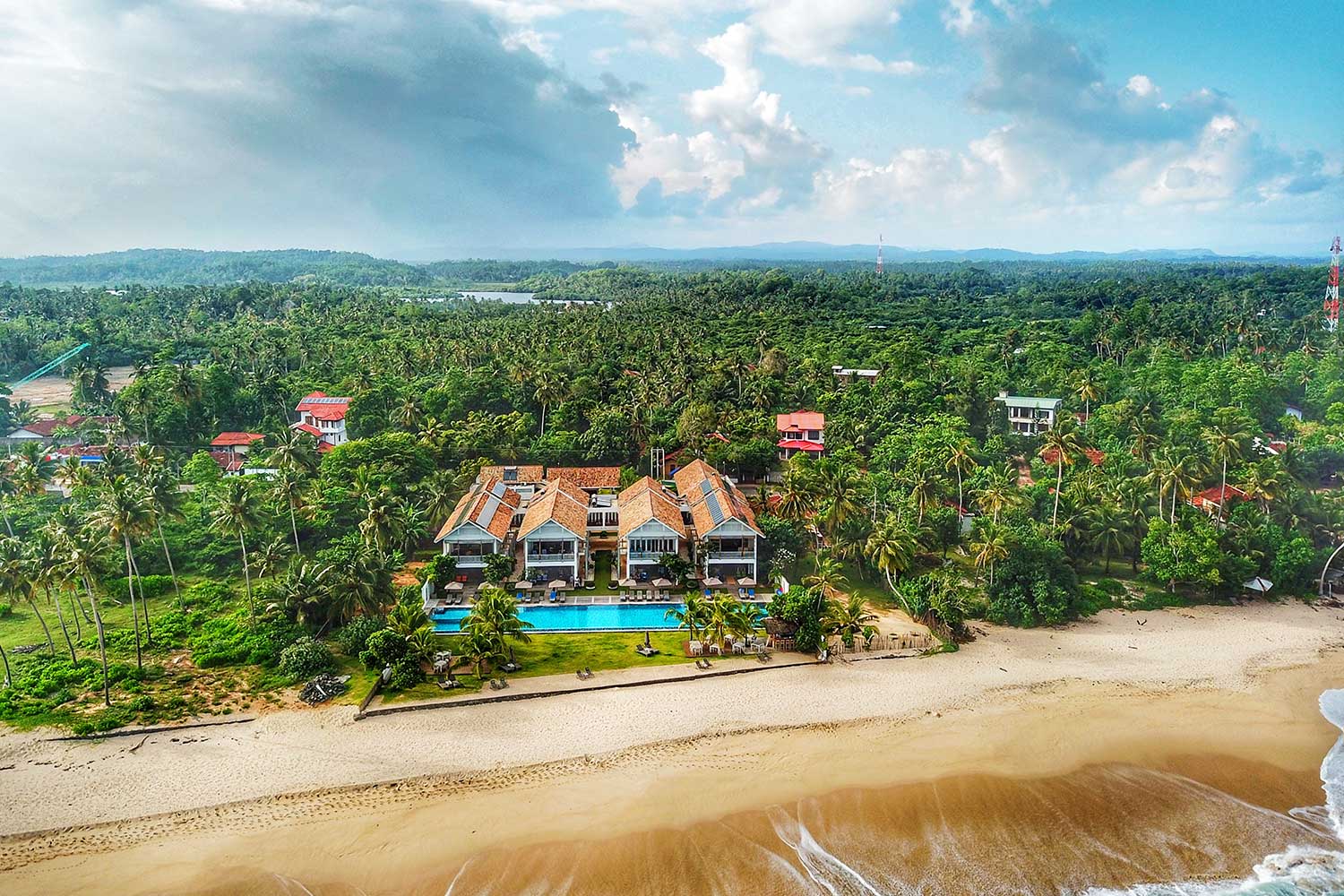 Boutique hotelSri Sharavi Beach Villas & SpaOn the beach at Kamburugamuwa, at the 153 km post on the Matara road, about 3 km east of Mirissa
 Boutique hotelLantern Boutique HotelOn the beach at 71 Galle Road, Kamburugamuwa, about 3 km east of Mirissa Bay
 VillaUbuntu Beach VillasOn the beach at 53A Galle Road, Kamburugamuwa, about 3 km east of Mirissa Bay, beside Lantern Boutique Hotel
 VillaMount Cinnamon, Mirissa HillsAt the top of a 40-acre working cinnamon estate on Henwalle Road, inland from Weligama Bay between Weligama and Mirissa
 Boutique hotelTriple O SixOn the Matara road at Bandaramulla, Mirissa, a short walk from Mirissa Beach and Coconut Tree Hill
Things to do from Mirissa
- Culture and heritage · a short stop on the Matara roadKushta Raja Gala, the rock-cut figure at WeligamaKushta Raja Gala is a relief about 3 m tall carved into a rock face on the edge of Weligama, and it is thought to be all that remains of the old Agrabodhi monastery that once stood there. It shows the Bodhisattva Avalokitesvara, known by the small seated Buddha in his crown, and is dated to between the 6th and 9th centuries AD.
- Culture and heritage · a morning or an afternoon, for both sitesKoggala: the folk museum and the painted temple at KataluwaThe folk museum at Koggala, about 15 minutes west of Weligama, is set around the ancestral home of Martin Wickramasinghe, regarded as the father of modern Sinhala literature, who was born here in 1890. Opened in 1981, it keeps the house with its original furniture and the writer's belongings, and newer galleries hold the folk crafts and tools of the southern countryside: farming, fishing, pottery and metalwork, masks, puppets, drums and the costumes of folk dance and ritual.
- Culture and heritage · a morning or an afternoonMatara: the Dutch Star Fort and the Weherahena templeMatara, about 15 minutes east of Mirissa, was a Dutch stronghold at the mouth of the Nilwala river. The Dutch rampart of the 1640s still closes off the promontory, topped since 1883 by a British clock tower, and across the river stands the small Star Fort, built between 1763 and 1765: a six-pointed star inside a moat, entered by a coral-faced gateway carved with the Dutch East India Company's insignia and the name Redoute Van Eck.
- Culture and heritage · a short visitThe great seated Buddha of Wewurukannala, DikwellaWewurukannala Vihara, at Dikwella about 20 minutes west of Tangalle, is known for its seated Buddha of 160 ft, about 50 m, the largest seated Buddha figure in Sri Lanka, as high as a building of 8 storeys, which rises above the old temple. The temple itself goes back to the late 18th century.
- Water and coast · a short visitThe Hummanaya blowhole at KudawellaHummanaya, near the fishing village of Kudawella, 12 km from Tangalle, is the only known blowhole in Sri Lanka. Sea water forced through a submerged cavern bursts up through the rock every couple of minutes, and the spray often reaches 25 to 30 m; its name comes from the 'hoo' it makes, heard some distance away.
- Culture and heritage · a guided walk and a visit to the peelersCinnamon peeling on an estate in the hills behind MirissaTrue cinnamon is native to Sri Lanka, which still grows 80 to 90% of the world's supply, and it is cultivated along the coastal belt as far south as Matara. In the hills behind Mirissa and Weligama, working estates open their plantations to visitors: one keeps a cinnamon museum among its 40 acres of trees, and another is shown on private tours by its resident owners.
- Culture and heritage · 2 to 3 hours, from 08:00 or from 16:00A walk around Galle FortGalle Fort was begun by the Portuguese and walled by the Dutch from 1649, and its 14 bastions enclose a lived-in town of about 52 ha, a UNESCO World Heritage Site since 1988. Its grid of low gabled houses with verandas, churches, mosques and old warehouses is still home to a mixed community.
- Culture and heritage · about 1.5 hoursA tea estate near the sea at AhangamaTea is not only a hill-country crop: the warm, wet low country of the Galle and Matara districts grows a strong, astringent tea. A few minutes inland from the sea at Ahangama, a family estate opens its tea gardens and factory to visitors.
- Culture and heritage · about an hour, from first lightThe stilt fishermen of the south coastStilt fishing, ritipanna, is practised in only 3 places, all on the south coast: Koggala and Ahangama in Galle district and Weligama. Each fisherman sits on a crossbar tied to a single pole set in chest-deep water and casts a kithul-wood rod beyond the surf for small fish such as sardines and mackerel.
- Nature and wildlife · 3 to 5 hours, leaving the harbour at about 06:30Whale watching from MirissaThe continental shelf drops away sharply off Mirissa, so blue whales pass close to the south coast on their seasonal migration, and the town is one of the island's main whale and dolphin watching bases. Boats leave the harbour at about 06:30, for the calmest water and the best light.
- Adventure · about 90 minutes a lessonSurf lessons on the south coastWeligama Bay is where most people learn: a long sandy beach with no reef, waves that break gently, and water shallow enough to stand in across much of the bay, at 27 to 29 °C all year. A lesson of about 90 minutes starts on the sand with safety and technique, then moves into the water beside the instructor.
- Culture and heritage · about 2 hoursA pottery lesson in a village near WeligamaKumbalgama, a village near Weligama, has a long tradition of making pottery, and its potters open their home workshops to small groups. The session shows each stage of the craft, from preparing the raw clay to shaping it on the wheel, drying it in the sun and firing it.
- Wellness · a private class, or a retreat of 5 to 8 daysYoga on the south coastThe south coast, around Weligama, Ahangama, Mirissa, Hiriketiya and Tangalle, is where many of the island's yoga retreats are based, often paired with surfing. Hatha, vinyasa and yin are the usual styles, taught in open-sided shalas facing the sea or set among the palms.
- Culture and heritage · about 1.5 hoursDondra Head, the island's southern tipDondra Head, 6 km south-east of Matara, is the southernmost point of Sri Lanka and carries the island's tallest lighthouse, a 49 m tower completed in 1890. The town behind it is Devinuwara, 'city of the gods', which gives the headland its name.
Mirissa in your journey? Build it in Explore.