The Perahera comesin July.
6 min read
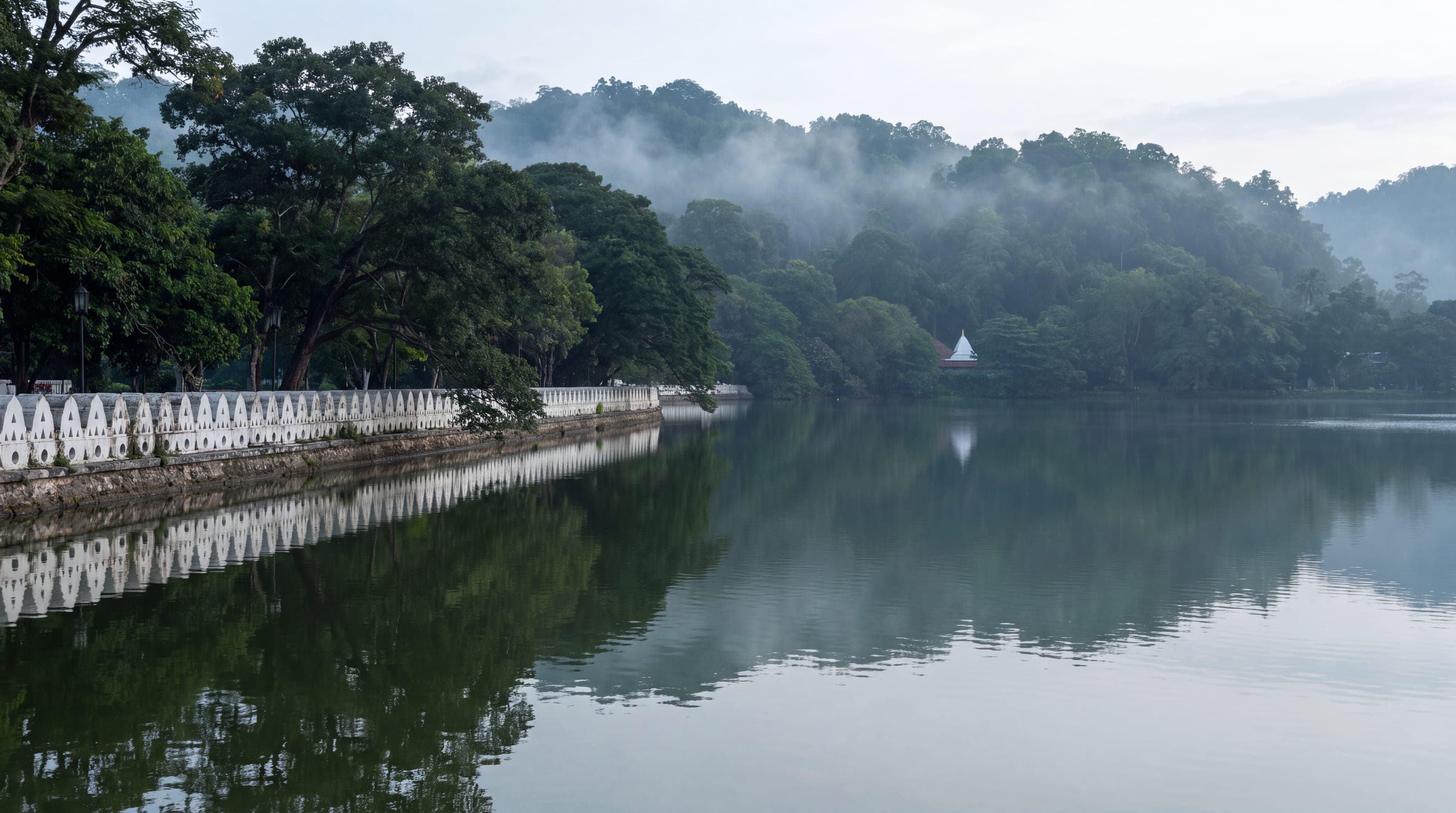
Kandy · the lake
What the Esala Perahera actually is, how to be positioned for it, and why the crowd on the final night is part of the occasion, not an obstacle to it.
The Esala Perahera is an annual procession held in Kandy in July and August, specifically during the lunar month of Esala, which runs from late July into early August. The procession originates from the Temple of the Tooth Relic, the Dalada Maligawa, and circles the lake and the surrounding streets for ten successive nights, growing longer each night. The final night, the Maha Perahera, is the longest, beginning at dusk and running for hours. In most years the Maha Perahera falls in August, its precise date set by the Nikini full moon.
The date moves, and it moves late. The Perahera is fixed to the lunar calendar rather than the civil one, so the ten nights fall differently each year and the final date is confirmed by the Maligawa in its own time. This matters more than it sounds: the stands, the rooms with a view of the route and the drivers who know how to reach them are all committed long before most travellers have decided which month they are coming. We hold provisional arrangements against the expected window and confirm them the moment the dates are published.
What is actually being carried
The Perahera is not a tourist event that happens to involve elephants. It is a religious procession in which the sacred casket believed to hold the Tooth Relic of the Buddha is carried on the back of the Maligawa Tusker through the streets of Kandy. The Tusker, always a male elephant of size and temperament suited to the occasion, carries an elaborately jewelled howdah. He walks at the centre of a procession of elephants, drummers, dancers and torch-bearers who have rehearsed their roles for months. The crowd gathered on the final night is there for the passage of the relic. That is the point of the occasion.
Watch the drummers rather than the elephants, at least for the first stretch. The geta bera players lead the sections, and the dancers who follow them belong to schools that hold their own repertoire, so the procession is not one performance repeated but a sequence of them, each with a different pulse. Whip-crackers move ahead of the first elephants to clear the road, and the sound arrives long before anything is visible. By the time the Tusker approaches you will have been listening for over an hour, which is the point: the procession teaches you how to hear it before it shows you the thing you came for.
Where you sit, and why it matters
You sit for the length of it in a reserved seat on a canvas-covered stand on the lake road, close enough to feel the heat from the torches and to hear the distinction between Kandyan and low-country drumming. The stands worth occupying face the lake circuit at the point where the procession makes its turn, that is where the full length of the procession becomes visible for the first time. The Maligawa Tusker passes at approximately the midpoint, surrounded by torch-bearers and the white-clad officials of the Dalada Maligawa. You do not see him first. You hear the change in the crowd.
Plan for a long evening rather than an event. Stands open well before the procession reaches them and the road closes earlier still, so you are in your seat a good while before anything happens and you stay there for hours once it does. Take a cushion if your back requires one, something to cover your shoulders after dark, and less than you think you need in a bag. Leaving early is possible in theory and unpleasant in practice, since the crowd behind the stands is at its deepest exactly when the procession is at its best.
Booking, and the week around it
Kandy at Perahera time is fully booked in the town centre and around the lake from mid-July onward. Properties that offer a view of the procession route from a private terrace, and a small number do, are gone by March for the August window. We arrange both stands and accommodation as a unit; one without the other produces a diminished experience. The road up from Colombo on the day of the Maha Perahera is a long drive that becomes considerably longer in procession-week traffic; we route guests through the highlands to arrive in Kandy the previous afternoon, which allows for the Maligawa visit and the context that makes the procession legible before it begins.
The Maligawa itself is worth the morning before, and it asks something of you: shoulders and knees covered, shoes left at the entrance, white or muted clothing rather than bright. It is an active place of worship with a queue of pilgrims carrying lotus flowers, not a monument with a ticket desk, and the difference is visible in how people move through it. Going first makes the procession legible. Without it the Perahera is a spectacle; with it you understand why the casket is at the centre and everything else is arranged around its passage.
The ten nights, and which to choose
The procession runs for ten nights at varying length. The first nights, the Kumbal Perahera, are smaller and considerably easier to attend: stands are available, the routes are accessible, and the procession is a fraction of its final size. For a guest new to this kind of occasion, the third night of the Kumbal Perahera is a more manageable introduction. The Maha Perahera on the final night is the one worth the journey, but the earlier nights are not preparation: they are a different, quieter version of the same thing.
A note on photographing it, since almost everyone intends to. Flash is intrusive at close range and the light is difficult in any case: the procession is lit by fire and moves continuously, so the frames that work are the ones that accept blur rather than fight it. The more useful decision is to put the camera down for the section carrying the relic. Guests consistently report that the part they remember is the part they did not photograph, and the crowd around you is not treating it as a photograph opportunity either.
The days between the nights are worth planning too. Kandy in Perahera week runs late and starts slowly, so the mornings are the usable part: the gardens at Peradeniya before the heat, the walk around the lake, the workshops in the villages above the town where the drums and the costumes are actually made. Guests who treat the daylight hours as recovery rather than sightseeing enjoy the evenings considerably more. Ten consecutive late nights is not a schedule anyone should attempt, and we do not build one.
A journey built around it
A journey to Kandy that arrives in the week of the Maha Perahera is not a journey with a festival attached to it. It is a different journey than any other week of the year. Sri Lanka has a handful of occasions on this scale, the Nallur Kandaswamy festival in Jaffna and the Vel festival in Colombo among them, where the event restructures everything around it. The Perahera is the one that draws the furthest. We send guests to it every year.
If the dates do not fall in your window, the honest answer is that they do not, and we will say so rather than build a lesser version of it. Kandy has the Maligawa, the hills behind it and the route down into the tea country in any month of the year, and a journey through it in April or November is a good journey. It is simply not this one. The Perahera is worth arranging a year around, and for the guests who do, it becomes the fixed point that the rest of the itinerary is hung on.
“You do not see the Maligawa Tusker first. You hear the change in the crowd.”
